

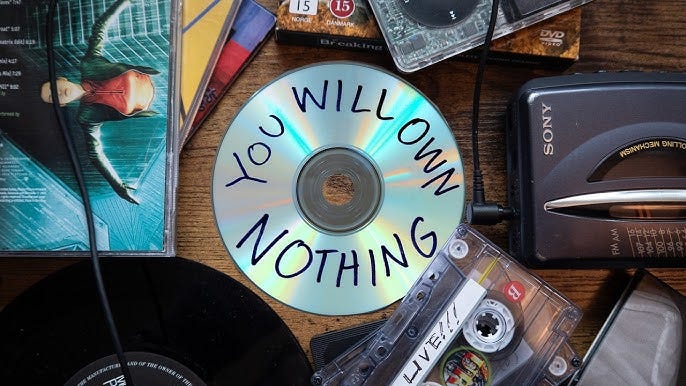
The Nostalgia
Ever since I could remember, physical media has been part of my life. Whether it was renting movies/buying movies or saving every penny to get the new Pokémon game – I was always happy to have my new piece of media that I consume to my heart’s content. I remember my nightly routine as a nine-year-old was to wait until my brother was done playing Mortal Kombat – I would quickly take his disc out of the PlayStation 2, run over to our bookshelf in the corner of the room, and shove it back in our media binder. I would sift through the pages, find my copy of Star Wars Battlefront II, and run back over before placing it in the disc tray. After I exhausted myself from dusting droids or was simply reprimanded to “get off the damn game”, I would run back over to that bookshelf, grab my media binder again, and choose which movie I’d be falling asleep to – spoiler alert, it was ALWAYS Star Wars. I would tuck myself into bed quickly like the static of the TV was a timer about to tick off. After a few minutes of aiming the controller at my insignia tube TV (with a built-in DVD player, might I add!) like I was back in Battlefront II, my movie would spin up and I’d be off to bed before Qui-Gon could talk about Midi-chlorians. I’m not telling this story because I was some Star Wars-obsessed kid – but because I see those discs I talk about every day. Whenever I look at some piece of tech from my childhood – memories such as this one flood my mind. Technology, especially in analog forms of it, has this effect on people currently in their 30’s that I think has never been seen before – I mean, it has literally matured with us. We’re in this unique age group where we are tech literate enough to effectively use a computer, but we also remember a time when we had to blow into a Nintendo 64 cartridge to get the game to work.
The Shift: What Happened?
Now, as time went on as it usually does – and the 2000s ended, things began to change. We saw companies like Netflix move over from mailing your movies to creating a streaming service. At first, it seemed like streaming was the way to go. The simplicity of having thousands of movies at a low cost carried more benefits than the alternative. We started to see more alternatives to different types of media – like Xbox Game Pass and PS Plus for video games and Spotify or Apple Music for music. The market began to flood with all types of subscription models for everything, and what we thought was convenience at a low cost quickly became an example of capitalism at its worst.
We are now in 2026, where subscription services have taken over the entire home entertainment sector. It has gotten to the point where computers do not even come with disc trays anymore. What was once an affordable system to enjoy your entertainment the quickest way possible is now worse than what cable used to be. Since these services have taken over and indoctrinated everyone into their system, we see price increases happening all the time. Just in the last year, Netflix has increased their prices once again, with the ad-free version being $27 USD. Spotify has also recently raised the cost of their service in February, raising their service to $13 USD. Despite these egregious price increases, we began to see drops in physical media sales throughout all forms of media. CD sales have steadily declined since their peak in the early 2000s, and movies have been taken over by streaming platforms. One of the most important ways of consuming media was quickly and quietly becoming obsolete as billionaires profited off the guise of “convenience”. Just in 2024, we saw giant companies like Best Buy and Target pull away from physical media – barring some new musical releases where you can see the shelves filled with whatever new Taylor Swift vinyl is out (it seems like there’s one every week!). So where does this end?
The Comeback: Revival
2026 is already one odd year – for more reasons than not. The United States is ever-so-clearly run by someone whose main objective is to fill the pockets of billionaires. The year began with news of a purchase deal – where Netflix was in talks of purchasing Warner Bros., one of the “Big Five” in major film studios. To explain in the shortest number of words why this is a horrible deal that should never have even been able to be conjured in the first place: imagine a world where films like One Battle After Another, Sinners, and Dune Part 3 were straight-to-streaming slop. Just days after the announcement of Netflix’s “big win”, they raised their prices. As the well runs dry for many Americans, actions like this make them exhausted – why pay these absurd prices when what is offered to you isn’t even substantial enough to warrant the price.
Another way the straw broke the camel’s back was TikTok – not the app itself but the vastness at which information spreads. Current trends are focused around 2016 nostalgia and yearning for analog tech. It has suddenly become cool again to want an iPod! The price of used tech has skyrocketed, with some prices rivaling some of the modern tech out right now. You can walk into any GameStop (who on earth wants to do that?) and purchase a used Nintendo 3DS for $400. That is $50 cheaper than Nintendo’s shiny new toy, the Nintendo Switch 2. While we can argue the semantics of price gouging products, it can still serve as an indicator that the demand for them is there.
Almost every day for the past few months has been positive news for physical media. We’ve seen Criterion hit record sales each time. We are seeing companies like Netflix fold to the pressure and release more of their content in physical form. Within the last month, we’ve seen a 4K/Blu-ray release of Stranger Things get a release date. Criterion also announced physical releases of Frankenstein and K-Pop Demon Hunters – which are two of Netflix’s biggest releases of 2025. Considering Netflix is the front face of streaming services, seeing them agree to releases like this is a major victory for the community. With companies in Japan also vowing to continue the production of devices like Blu-ray players, there are only bright days ahead for people who love hoarding their favorite films!
The Evolution: Adapting
It is undeniable that, while very cool, physical pieces of analog tech are quite inconvenient. Arguing about everything I have even written above can sound silly at times because it often gets shut down with the point of convenience. Why use an old iPod that has a bad screen and uses wired headphones that seem to get more tangled with every pocket shove? Why use toothpaste on a disc that falls on the ground and gets scratches when you can just use an Apple TV? Why blow into a game cart when you can just download it from the online shop? While all these things sound easier to use, it strips people of their intention. The idea is that eventually, you’ll give away your agency to these algorithms and just allow them to do the work for you. Curation is a huge driver in bringing me back to my collection. The idea that I can still choose what I consume is enough to keep me going in this hobby. Another major point of contention is ownership. The idea of having something they cannot alter or take away is probably the biggest argument you’ll hear amongst collectors. The idea of having a tangible piece of art that they can call their own is enough to keep them going. Everyone has their reasons to collect media, and I think that is the beauty of this hobby – you get to collect things the way YOU want to.
Now comes a harsh reality that some might not want to hear… taking on more digital content has its benefits too. Now I don’t mean logging onto Amazon Prime and buying the newest release the second it drops. While you can do that, you’re not really purchasing ownership of the product but rather a license that lets you use it. I mean truly owning your digital media. You see, living so close to the city comes with its pros and cons, and one of the biggest cons is space. As much as I would love to have a library of discs and vinyl, it’s just not a reality at this point in my life. I spent all of 2025 planning an alternative that can still provide me with the joy that collecting brings me. One of my biggest projects going into this year was making a home media server that holds every piece of media that I can possibly own. It isn’t about owning the media for me; it’s about having it be accessible and affordable. Since starting the project, I have a media server running on a mini-PC in its own little spot in the living room. Here is where I rip my DVDs and CDs, store them onto a drive (it’s backed up, don’t worry!) and enjoy my media “the convenient way”. With this media server, I still engage with the media in the traditional way while adopting new advancements that let me enjoy art the way I want to. While it can cost an arm and a leg to get one of these up and functional, you can start with that old laptop you have collecting dust in your closet.
Having one of these servers also allows me to sail the high seas (argh!) where I can find media that isn’t available to purchase whatsoever. One of my favorite shows currently airing is RuPaul’s Drag Race, and the only way I can watch it is by having Paramount+ for the main series, WOW Presents Plus for the global seasons, and Amazon Prime for the All-Stars seasons. This is upwards of $50 a month just to be able to binge-watch some good TV. I took matters into my own hands in this case and set sail, where I found every season up until the current airing one and retrieved them. In my opinion, if buying isn’t owning, being a pirate is not stealing. Now I can enjoy them whichever way I want to. I even plan on making physical versions of my own that I can have at my house whenever I want to pop in a disc and enjoy the series.
The Conclusion: Physical Media Forever!
I believe that this physical media trend boils down to people just being exhausted by being constantly connected. Simply put, our phones are an addiction that companies feed off. They will always try to find ways to make more money, and with the way things are going, they are barely even ashamed of it at this point. Nothing brings me more joy than scrolling online and seeing younger people talk about movie hauls or CD hauls, because for a while, I thought all of that was coming to an end. Media preservation, whether it’s discs and vinyl or a hard drive on an old dusty computer, is vital to the preservation of art. The attempt at its removal is simply an attempt to rid us of what makes art so special. I encourage anyone to go into physical media collecting with a new perspective. Search local bin stores or even sites like eBay to keep used prints in circulation, visit boutique sites like Criterion for new releases of older films, and if cost is an issue, visit your local library! Most libraries have a repertoire of movies, games, and music at no cost. It is an infinitely valuable resource that is very underutilized today. The point of me writing this is to show my passion for collecting and explain why I do it. If this essay was enough to get just one person to consider collecting media, I would deem it a success. Though new releases would be harder to get if more people got into the hobby, that is a price I would pay to keep this hobby around. Physical media forever!